
Brainstorming Session
on
Organic Fruits and Vegetables: Profitability and Certification Challenges
November 14, 2026
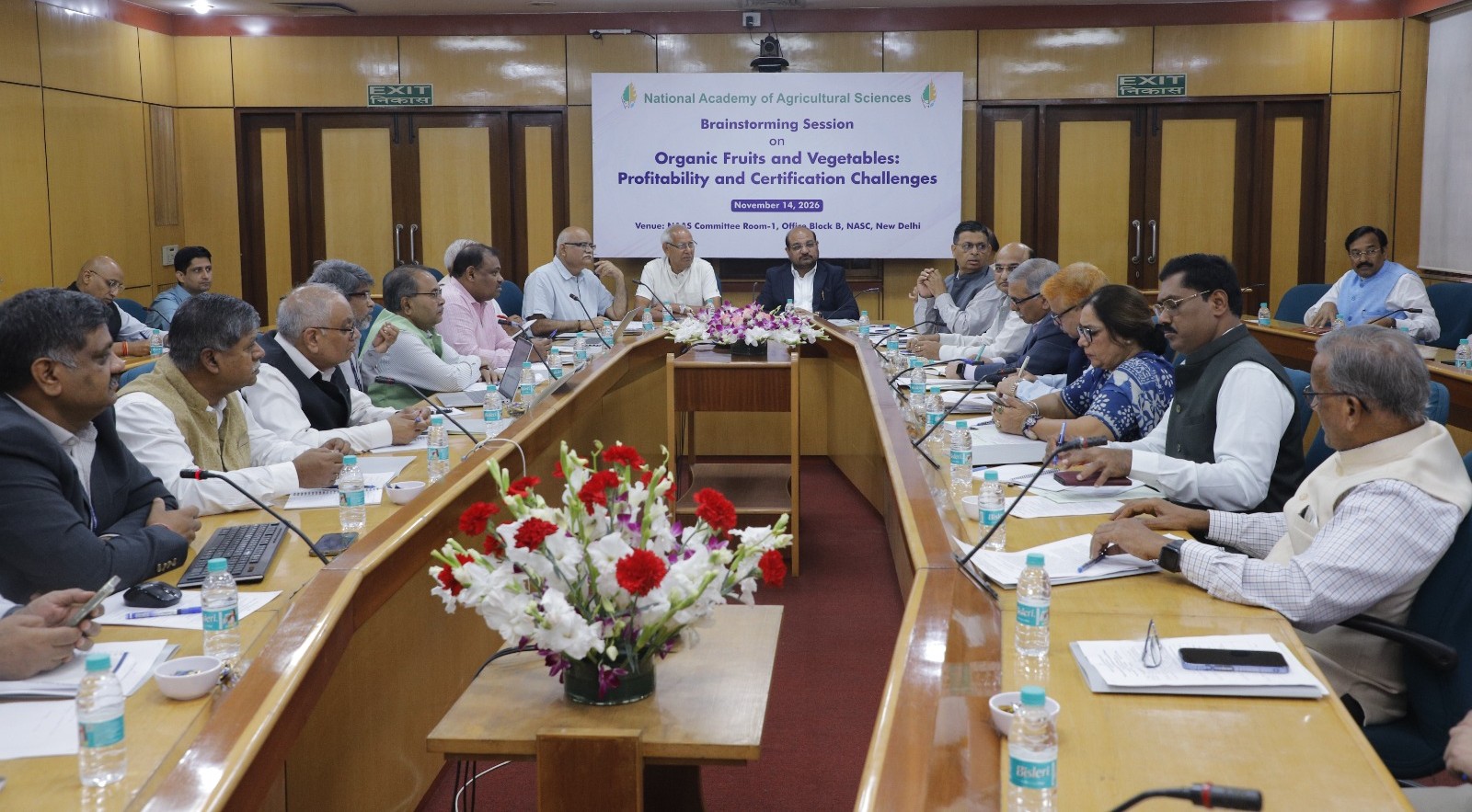
The Academy organized a Brainstorming Session on “Organic Fruits and Vegetables: Profitability and Certification Challenges” on November 14, 2026, in hybrid mode, under the chairmanship of Dr. M. L. Jat, President, NAAS. Dr. Sanjay K. Singh, DDG (Horticultural Science), and Dr. V. B. Patel, ADG (Horticultural Science), ICAR, served as Conveners. Dr. B. S. Dwivedi, Secretary, NAAS, welcomed the participants and briefed them about the programme.
Presenting the base paper, Dr. V. B. Patel highlighted that India’s horticultural production stands at about 378 million tonnes and there is great scope for scientific organic production for enhancing domestic availability of organic produce and exports including processed products.Status, challenges, opportunities, comparative advantage and policy support through the government programs, questions to be addressed through brainstorming session were also presented by him.
Inhis remarks, Dr. M. L. Jat emphasised the need for a robust, science-based strategy to promote organic fruits and vegetables, guided by domestic and international demand. He emphasized the importance of assessing production, supply chains, market access, consumer affordability and regional and seasonal price variations to bridge farm-gate and retail price gaps. He also stressed systematic research to establish linkages between nutritional quality of organic produce and human health.He called for institutional convergence and a platform connecting all stakeholders and need to have comprehensive database of scientific and farmer-led best practices, alongside meta-analysis of multi-location studies.
The session brought together scientists, policy makers, certification and trade experts, entrepreneurs and farmer representatives. Panel discussions were held on production systems, productivity and transition; profitability, farmgate premiums and support; certification, traceability and consumer confidence; markets, produce aggregation and post-harvest management; field experience; and policy convergence and institutional coordination. The need for varieties developed specifically for organic farming, with resistance to pests and diseases, use of wild relatives and participatory breeding, and for priority to indigenous crops was highlighted. Community-based pest management, assessment of pest and disease losses under organic and natural farming, and recommendation of effective microbial biologicals were stressed. On profitability, full cost accounting including transition costs, market segmentation and grading, trust-based consumer markets, peri-urban and kitchen-garden production, involvement of KVKs, and buyer-linked production clusters were suggested.
Overall, the session underscored that the growth of organic fruits and vegetables will depend on a combination of reduced transition costs, region-specific production and pest management systems, suitable varieties, robust and harmonized certification, traceability, strong market linkages and consumer confidence, supported by research, enabling policies, farmer organizations and responsible industry partnerships.
Dr. Sanjay K. Singhemphasised the need for quality input systems, integration of GI crops into organic production systems, and focused research to address key challenges in strengthening organic horticulture. He thanked the Academy and all the participants.
© National Academy of Agricultural Sciences, 2016. All Rights Reserved.